Homeowners' pick for appliance repair across Texas
Oven Repair — Book a Visit Today
Most ovens quit for one of a handful of reasons, and we fix all of them on all major brands as an independent shop. The bake element cracks. A gas igniter gets weak and clicks and clicks without ever lighting. Sensors and thermostats drift, so the dial reads 375 while the inside sits at 300. Control boards fail, and sagging door hinges let heat pour right out. On a visit we run the oven, read the sensor, check voltage or gas flow, then pull the back panel to look at the parts doing the work. After that we tell you plainly what failed and what it takes to fix. Call us and describe what your oven is doing.
Call (888) 857-9883- A real person answers
- Open 7 days
- Written quote before work starts
Taking calls until 5:00 PM CT
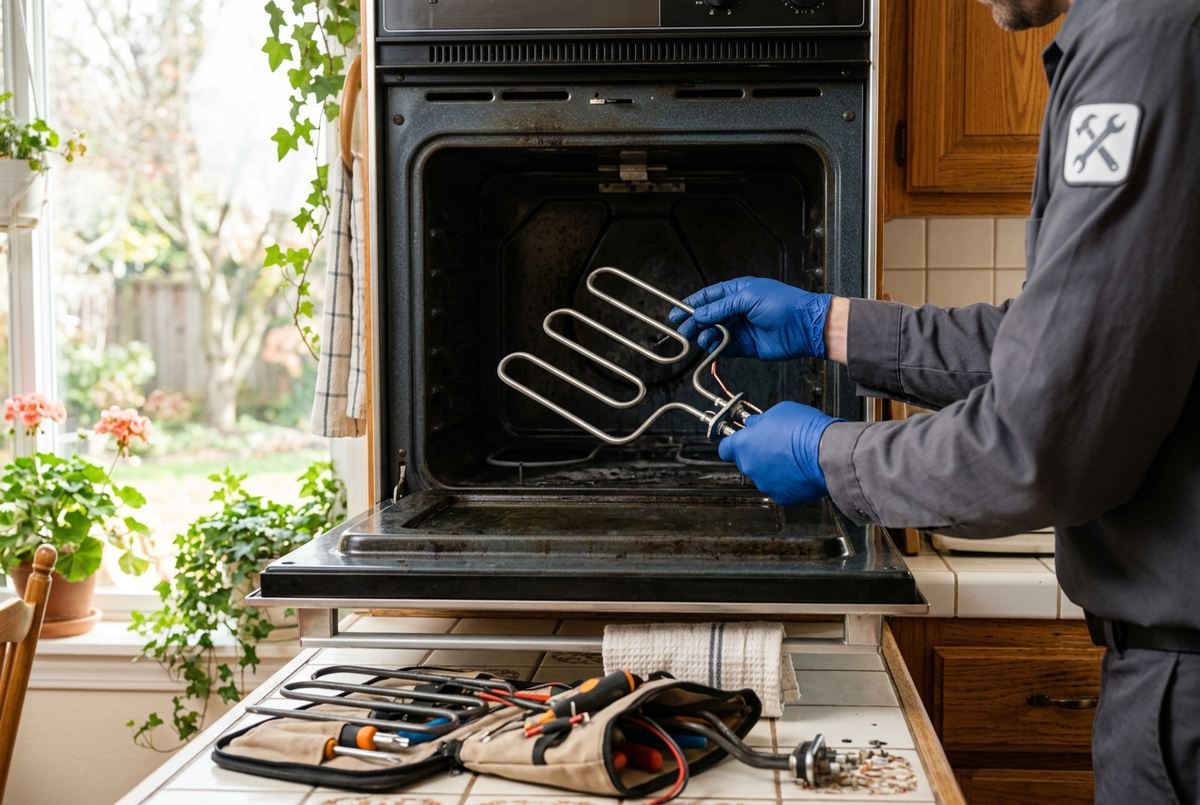
The oven symptoms we hear most
- "It never gets hot enough" Weak bake element, a temperature sensor that has drifted, or a thermostat out of calibration.
- "It clicks over and over but won't light" Tired gas igniter that isn't drawing enough current to open the safety valve.
- "Cookies burn on one side, raw on the other" Dead convection fan, warped element, or a door that no longer seals.
- "The display shows an error and locks up" Control board fault, a shorted keypad, or a door lock motor that's stuck.
- "Smells like something's burning inside the walls" Scorched wiring at an element terminal, or a connector block cooked by heat.
Safe things to check first
Worth a look before you call — sometimes it saves you the visit.
- 1Confirm the oven is on the right mode, and that no delay-bake or Sabbath setting is holding it back.
- 2Check the breaker. Many ranges run off a double breaker, and half can trip while the cooktop still works.
- 3Take a flashlight to the bake element and look for cracks, blisters, or a bright split in the coil.
- 4Close the door and run your hand around the edges. Heat escaping there means a worn gasket or a sagging hinge.
What homeowners get from an independent shop
| Appliance Tech | Big-box repair chains | Handyman listings | |
|---|---|---|---|
| Written quote before any work | ✓ | ✕ | ✕ |
| Live answer seven days a week | ✓ | ✕ | ✓ |
| All major brands, gas and electric | ✓ | ✓ | ✕ |
| Independent, no manufacturer quotas | ✓ | ✕ | ✓ |
| Crews familiar with homes like yours | ✓ | ✕ | ✓ |
What homeowners say after the visit
“He explained every step before touching a screw. Quote on paper first, then the work.”
Luis G.El Paso, TX“Our oven was running forty degrees cold for months. One sensor later, cookies come out right again.”
Renee W.Plano, TX“No upsell talk at all. He fixed the drain pump and pointed out a hose I should watch, that was it.”
Jeff D.Garland, TXOven Repair — quick answers
Is my oven worth repairing or should I replace it?
Depends on what failed. Elements, igniters, and sensors are common repairs on an oven that's otherwise sound. If the cavity is rusted through, or several major parts are done at once, we'll say so and let you decide.
Why does my oven bake unevenly now?
Heat has to move around and stay inside the box. A dead convection fan, a cracked element, or a leaking door gasket will throw off the balance. We measure the actual cavity temperature instead of trusting the display.
Can you fix both gas and electric ovens?
Yes. Gas ovens usually come down to igniters, safety valves, or burner tubes. Electric ovens are elements, sensors, and boards. We work on wall ovens, freestanding ranges, and slide-ins from all major brands.
Does hard water affect an oven?
Not the way it chews up dishwashers. But West Texas dust and scale off steam-clean cycles can crust up sensors and door seals, and mineral film builds on glass doors. We clean what we can reach while we're there.
My oven runs but the broiler is dead. Same problem?
Usually not. Broil and bake use separate elements, or separate gas burners, each with its own wiring path. One can fail while the other keeps right on working. We test both circuits before deciding what to replace.
How long does an oven repair usually take?
Most single-part repairs finish in one visit once we've found the fault. Control boards and certain brand-specific parts may have to be ordered. We tell you the plan before we start, so nothing surprises you.
How it works
- Step 1
Tell us the symptom
Call us or fill out the form and describe what you hear, smell, or see. A noise, a leak, an error code, a burning odor. Give us the brand and rough age if you know them.
- Step 2
We come look
A technician shows up with common parts on the truck. We test the machine instead of guessing. Then we explain what failed in plain words, and what the repair takes, before anything gets opened up.
- Step 3
You decide, we repair
Nothing gets replaced without your go-ahead. Most repairs finish the same visit. If a part has to be ordered, we tell you straight and set a return time that works for your day.
- A real person answers
- Open 7 days
- Written quote before work starts
Why homeowners call us
- Hard water is our specialtyWest Texas scale wrecks dishwashers, ice makers, and water valves, and we see it daily. Spray arms clog. Heating elements crust over and inlet screens choke up white. We clean and replace the parts scale eats first.
- Built for Texas summersHeat pushes refrigerators and freezers hard. Condenser coils pack with dust, compressors run nonstop, and garage freezers quit in triple digits. We check cooling systems for heat load, not just for the obvious broken part.
- Plain talk, no runaroundWe tell you what died and why. If a machine is not worth fixing, we say so. You get the reasoning instead of a sales pitch, and you make the call yourself.
- Most brands, most machinesWashers, dryers, ranges, ovens, dishwashers, fridges, freezers. We work as an independent shop on all major brands, top load and front load, gas and electric. One call covers the laundry room and the kitchen.
- All major brands, gas & electricEvery major appliance brand, gas and electric, handled by an independent shop.
- Straight answersWhen a repair doesn't make sense, we tell you, sometimes before we even roll a truck.
Oven Repair
Small faults become big ones on a schedule of their own
Describe the symptoms and we'll book the visit — takes about a minute.
- A real person answers
- Open 7 days
- Written quotes
- All major brands
- Gas & electric
Rather not call? Get a free quote →