Homeowners' pick for appliance repair across Texas
Dryer Vent Cleaning & Repair — Book a Visit Today
We clean and repair dryer vents across Texas, and the fix starts at the dryer itself. Lint doesn't stay in the trap. It packs the duct behind the dryer, chokes the airflow, and turns a 45-minute load into a three-hour chore. Crushed flex hose, birds nesting in a roof cap, a vent hood flap glued shut with lint paste, we see all of it. We pull the dryer out, check the transition hose, then clear the full run to the exterior cap with brushes and air. Damaged sections get replaced, not taped over, and we verify airflow at the hood before we leave. Burning smells or a dryer that shuts itself off mid-cycle should not wait. Call us and tell us what you're smelling and hearing.
Call (888) 857-9883- A real person answers
- Open 7 days
- Written quote before work starts
Taking calls until 5:00 PM CT
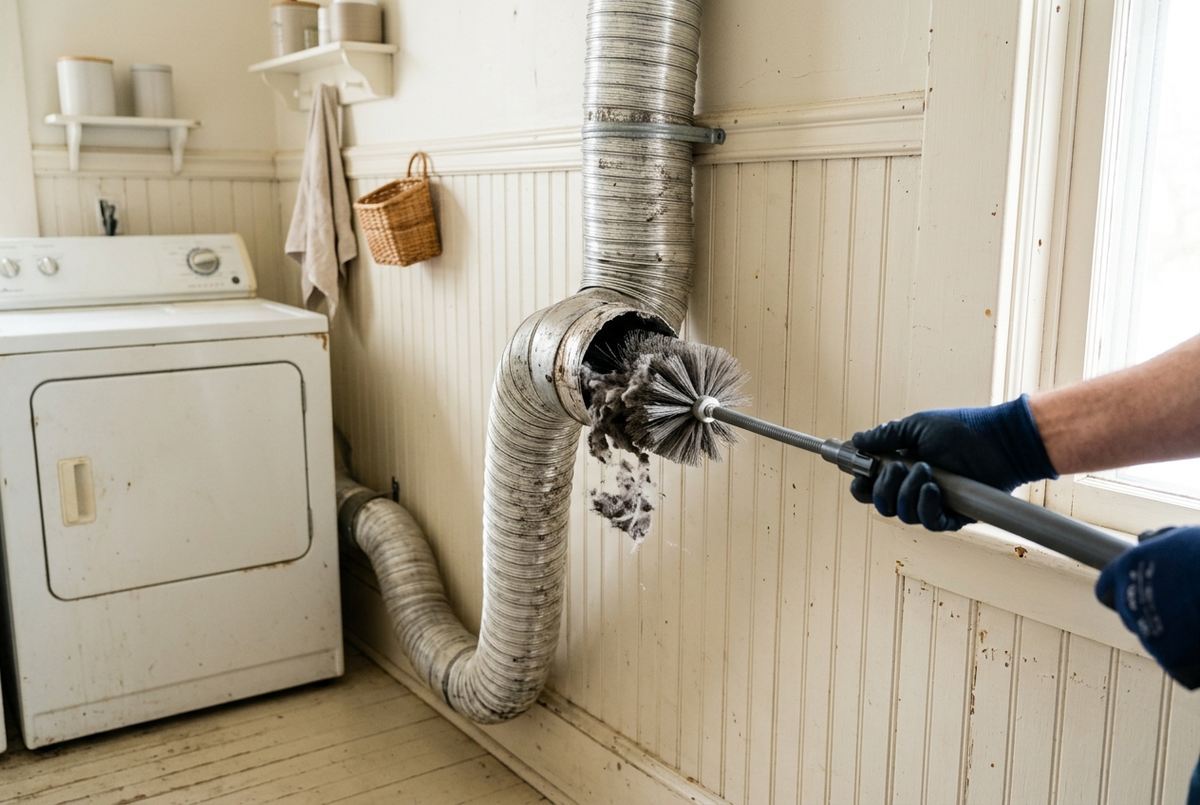
The dryer vent cleaning & symptoms we hear most
- Towels take three cycles to dry Blocked or restricted vent run choking the exhaust airflow
- The laundry room feels like a sauna A disconnected or leaking duct is dumping hot moist air indoors
- Something smells like it's burning Lint packed against the heater element or inside the blower housing
- Clothes come out scorching hot to the touch Trapped heat from poor exhaust, often with a thermal cutoff about to trip
- No air moving at the outside flap Crushed hose, collapsed duct, or a bird nest at the exterior cap
Safe things to check first
Worth a look before you call — sometimes it saves you the visit.
- 1Peek behind the dryer and see if the flex hose is kinked or crushed against the wall.
- 2Go outside while the dryer runs and feel whether the vent flap is open and pushing warm air.
- 3Pull the lint screen and hold it under running water. If water beads up and sits there, softener residue is blocking it.
- 4Look for lint dust piling up on the floor or wall behind the dryer, which points to a loose duct joint.
What homeowners get from an independent shop
| Appliance Tech | Big-box repair chains | Handyman listings | |
|---|---|---|---|
| Written quote before any work | ✓ | ✕ | ✕ |
| Live answer seven days a week | ✓ | ✕ | ✓ |
| All major brands, gas and electric | ✓ | ✓ | ✕ |
| Independent, no manufacturer quotas | ✓ | ✕ | ✓ |
| Crews familiar with homes like yours | ✓ | ✕ | ✓ |
What homeowners say after the visit
“Freezer section thawed overnight. They triaged by phone, fit us in early, and saved most of the meat.”
Opal S.El Paso, TX“Third generation machine in our family and they treated it with respect instead of pushing something new.”
Ben H.Plano, TX“The tech double-checked gas connections before leaving even though the job was electric. Careful people.”
Lois W.Garland, TXDryer Vent Cleaning & Repair — quick answers
How often should a dryer vent be cleaned?
Once a year works for most households. Bigger families, pets that shed, or a long duct run through an attic can mean twice a year. If drying times keep creeping up between cleanings, that's your signal regardless of the calendar.
Can't I just vacuum it out myself?
A shop vac reaches the first few feet. The packed lint usually sits farther down, at elbows and the exterior cap. We run rotating brushes the full length and confirm airflow at the hood, which a vacuum at one end can't do.
Is a clogged vent really a fire risk?
Yes. Lint is fine, dry fuel sitting next to a heat source. Restricted airflow keeps the heater cycling longer and pushes temperatures up inside the cabinet. Clearing the duct is basic fire prevention, not an upsell.
My vent runs up through the roof. Can you still clean it?
We handle roof-terminated and long attic runs. Those collect more lint because of the vertical lift and the extra elbows. We clear from both ends when access allows, and we check the roof cap for nests and screen blockage.
Should I replace foil flex hose behind the dryer?
We recommend it. Thin foil crushes easily and its ridges catch lint. Rigid or semi-rigid metal transition duct moves more air and holds its shape when the dryer gets shoved back against the wall.
Do you fix the vent, not just clean it?
We do both. Crushed sections, disconnected joints, missing exterior hoods, and flaps rusted shut all get repaired or replaced. Cleaning a damaged duct just delays the same problem, so we address what we find.
How it works
- Step 1
Tell us the symptom
Call us or fill out the form and describe what you hear, smell, or see. A noise, a leak, an error code, a burning odor. Give us the brand and rough age if you know them.
- Step 2
We come look
A technician shows up with common parts on the truck. We test the machine instead of guessing. Then we explain what failed in plain words, and what the repair takes, before anything gets opened up.
- Step 3
You decide, we repair
Nothing gets replaced without your go-ahead. Most repairs finish the same visit. If a part has to be ordered, we tell you straight and set a return time that works for your day.
- A real person answers
- Open 7 days
- Written quote before work starts
Why homeowners call us
- Hard water is our specialtyWest Texas scale wrecks dishwashers, ice makers, and water valves, and we see it daily. Spray arms clog. Heating elements crust over and inlet screens choke up white. We clean and replace the parts scale eats first.
- Built for Texas summersHeat pushes refrigerators and freezers hard. Condenser coils pack with dust, compressors run nonstop, and garage freezers quit in triple digits. We check cooling systems for heat load, not just for the obvious broken part.
- Plain talk, no runaroundWe tell you what died and why. If a machine is not worth fixing, we say so. You get the reasoning instead of a sales pitch, and you make the call yourself.
- Most brands, most machinesWashers, dryers, ranges, ovens, dishwashers, fridges, freezers. We work as an independent shop on all major brands, top load and front load, gas and electric. One call covers the laundry room and the kitchen.
- All major brands, gas & electricEvery major appliance brand, gas and electric, handled by an independent shop.
- Straight answersWhen a repair doesn't make sense, we tell you, sometimes before we even roll a truck.
Dryer Vent Cleaning & Repair
Small faults become big ones on a schedule of their own
Describe the symptoms and we'll book the visit — takes about a minute.
- A real person answers
- Open 7 days
- Written quotes
- All major brands
- Gas & electric
Rather not call? Get a free quote →