Homeowners' pick for appliance repair across Texas
Ice Maker Repair — Book a Visit Today
Ice makers quit for a handful of reasons, and around here hard water tops the list. Scale clogs the inlet valve, coats the mold, and glues cubes into one lump. Other times it's a warm freezer, a kinked water line, a stuck ejector arm, a burned-out module, or a thermostat that never tells the machine to harvest. When we come out, we run a manual harvest cycle, check water pressure at the valve, read freezer temperature, and inspect the fill tube for a plug of ice. Then we tell you what part failed and what it takes to fix it. Built-in ice machines get the same treatment, plus a look at the pump and drain. Call us and describe what you're seeing.
Call (888) 857-9883- A real person answers
- Open 7 days
- Written quote before work starts
Taking calls until 5:00 PM CT
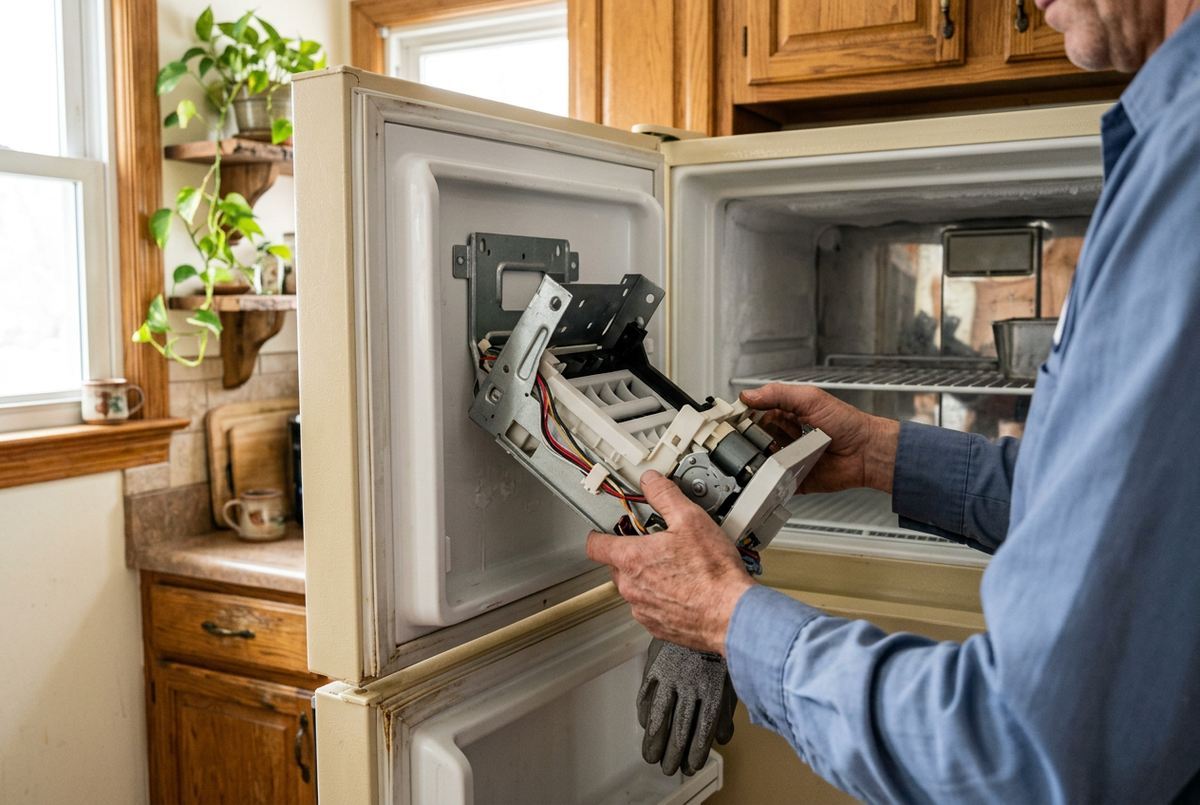
The ice maker symptoms we hear most
- Cubes come out hollow and tiny Low water fill: restricted inlet valve, scaled screen, or weak line pressure
- One giant frozen brick in the bin Slow leak past the valve or a fill tube icing over between cycles
- Bucket's empty and nothing's dropping Failed module or motor, open thermostat, or a bail arm stuck up
- Ice tastes like the freezer smells Old ice absorbing odors, stale water in the line, or a filter past due
- Water on the kitchen floor under the door Cracked line, loose compression fitting, or a drain path plugged with scale
Safe things to check first
Worth a look before you call — sometimes it saves you the visit.
- 1Make sure the wire bail arm or ice level lever isn't propped up in the off position.
- 2Check that the freezer sits near zero degrees, since warm freezers stall the harvest cycle.
- 3Look behind the fridge for a water line that got pinched when the unit was pushed back.
- 4See when the water filter was last changed, and confirm the house shutoff to the fridge is fully open.
Guides & troubleshooting
What homeowners get from an independent shop
| Appliance Tech | Big-box repair chains | Handyman listings | |
|---|---|---|---|
| Written quote before any work | ✓ | ✕ | ✕ |
| Live answer seven days a week | ✓ | ✕ | ✓ |
| All major brands, gas and electric | ✓ | ✓ | ✕ |
| Independent, no manufacturer quotas | ✓ | ✕ | ✓ |
| Crews familiar with homes like yours | ✓ | ✕ | ✓ |
What homeowners say after the visit
“No upsell talk at all. He fixed the drain pump and pointed out a hose I should watch, that was it.”
Jeff D.El Paso, TX“The scheduler actually listened to the symptoms and sent the guy with the right parts.”
Priya N.Plano, TX“Dishwasher stopped mid-cycle full of water. They walked me through draining it on the phone before the visit even happened.”
Carl H.Garland, TXIce Maker Repair — quick answers
Why does my ice maker work for a while, then quit?
Usually a part that fails when warm or a fill tube that ices shut after several cycles. Intermittent problems point to the valve, the module heater, or a thermostat losing contact. We watch a full cycle so we catch it in the act.
Does Lubbock water really wreck ice makers?
Hard water leaves scale on the inlet valve screen, the mold, and the pump on built-in machines. Scale slows fill, shrinks cubes, and makes ice cloudy. Regular descaling and filter changes stretch the life of the whole assembly.
Is it worth repairing an ice maker or should I buy a new fridge?
Depends on what failed. A valve, module, or thermostat is a straightforward part swap. Sealed system trouble in an older fridge is a bigger conversation. We diagnose first, then lay out the options plainly.
How long does a repair visit usually take?
Most ice maker jobs finish in one visit when the part is common. Diagnosis runs through fill, freeze, and harvest, which takes some waiting. If we need to order a specific module, we schedule the return trip before we leave.
My new ice maker still isn't making ice. What's wrong?
Fresh installs often need a day to reach temperature and prime the line. Check that the saddle valve or shutoff is open and the arm is down. Still nothing after 24 hours means water isn't reaching the mold.
Can you work on standalone or under-counter ice machines?
Yes. Those use a pump, a water reservoir, and a drain, so we check for scale buildup, a clogged drain, and dirty condenser coils. Summer heat in a closed cabinet also causes short cycling, so airflow gets a look too.
How it works
- Step 1
Tell us the symptom
Call us or fill out the form and describe what you hear, smell, or see. A noise, a leak, an error code, a burning odor. Give us the brand and rough age if you know them.
- Step 2
We come look
A technician shows up with common parts on the truck. We test the machine instead of guessing. Then we explain what failed in plain words, and what the repair takes, before anything gets opened up.
- Step 3
You decide, we repair
Nothing gets replaced without your go-ahead. Most repairs finish the same visit. If a part has to be ordered, we tell you straight and set a return time that works for your day.
- A real person answers
- Open 7 days
- Written quote before work starts
Why homeowners call us
- Hard water is our specialtyWest Texas scale wrecks dishwashers, ice makers, and water valves, and we see it daily. Spray arms clog. Heating elements crust over and inlet screens choke up white. We clean and replace the parts scale eats first.
- Built for Texas summersHeat pushes refrigerators and freezers hard. Condenser coils pack with dust, compressors run nonstop, and garage freezers quit in triple digits. We check cooling systems for heat load, not just for the obvious broken part.
- Plain talk, no runaroundWe tell you what died and why. If a machine is not worth fixing, we say so. You get the reasoning instead of a sales pitch, and you make the call yourself.
- Most brands, most machinesWashers, dryers, ranges, ovens, dishwashers, fridges, freezers. We work as an independent shop on all major brands, top load and front load, gas and electric. One call covers the laundry room and the kitchen.
- All major brands, gas & electricEvery major appliance brand, gas and electric, handled by an independent shop.
- Straight answersWhen a repair doesn't make sense, we tell you, sometimes before we even roll a truck.
Ice Maker Repair
Small faults become big ones on a schedule of their own
Describe the symptoms and we'll book the visit — takes about a minute.
- A real person answers
- Open 7 days
- Written quotes
- All major brands
- Gas & electric
Rather not call? Get a free quote →